





A Read the following sentences:
We live in Bangladesh.
It is a beautiful country.
Our mother language is Bangla.
We love our country and our language.
Count the number of words in each of these sentences. Each word in a sentence is a part of speech. There are eight parts of speech in English.
They are:
- Noun
- Pronoun
- Adjective
- Verb
- Adverb
- Preposition
- Conjunction
- Interjection.
B Read the following passage and look at the underlined words.
Shanta lives in Rajshahi with her parents. She is a student of class six. She goes to school regularly. She loves to read books. She also loves music. All her friends are fond of her.
These are all naming words. They are called nouns. Nouns are a large number of things. Here are some categories.
Names of people:
Names of countries:
Names of cities:
Names of foods:
Names of fruits:
Names of flowers:
Names of animals:
Names of qualities
Names of institutions:
Names of relations:
In fact, there is no end to this list. You can add many other things like these.
• Supply four nouns for each of the above categories. Also refer to the above passage and
• Say which of the underlined words refers to what category of names.
C Look at the underlined words in the following sentences:
I saw the boy sitting in the field. Some girls were also with him. They were discussing their problems of living in the school hostel.
Now say which of these words mean one person/thing and which ones mean more than one person/ thing.
When a noun refers to one person or thing, its form is singular. On the other hand, when a noun refers to more than one person or thing, its form is plural. Look at the following examples:
Singular
cat
dog
COW
bus
watch
church
box
baby
lady
story
Plural
cats
dogs
COWS
buses
watches
churches
boxes
babies
ladies
stories
Notice 's', 'es' and 'ies' have been used to form plurals in the above examples. These are called plural markers. 'The words ending with 's', 'x' and 'ch' have taken 'es' and the words ending with 'y' have taken 'ies' to form plurals.
But some plurals are irregular in their forms. For example:
Singular
man
child
tooth
mouse
goose
Plural
men
children
teeth
mice
geese
Notice how the plurals are formed in the above examples.
Note: In English plurals are usually formed by adding s, es or ies to the singular form.
D. Read the following passage and identify the nouns in it:
Mr. Habib is now a happy man for several reasons. Firstly, he has recently made a lot of money from his business. Secondly, he has bought two flats in Dhaka. Thirdly, his wife has recovered from her long illness. Fourthly, he has married of all his daughters. Finally, his son has got a good job. These are the causes of his present happiness.
Now say which of these nouns are singular and which of them are plural? Make sentences of your own with two singular nouns and two plural nouns.
E. Fill in the blanks in the following passage with appropriate singular and plural nouns:
Salam is a ____ of class 6. He has some very good _____ They go to ____ together. They also sit together in the _____ All _____ love them.
F. Write a sentence with each of the following nouns:
reasons, business, illness, marriage, happiness
A Read the following conversation and notice the underlined nouns:
Aslam: Excuse me, do you have pencils and erasers?
Shopkeeper: Yes, we have a lot. How many do you want?
Aslam: I need one pencil and one eraser.
Shopkeeper: Here you are.
Aslam: Thank you. Can I have a tube of toothpaste, please?
Shopkeeper: Certainly. Anything else?
Aslam: Oh yes, a bar of soap and a small bottle of coconut oil.
Shopkeeper: Just a minute.
Which of these nouns can and which of them cannot be counted? Those which you can count are called countable nouns and those which you cannot count are called uncountable nouns.
In the conversation, five items are underlined. Of them, 'pencil' and 'eraser' are countable nouns, because they can be counted. You can say,
A pencil, one pencil or two pencils
An eraser, one eraser or three erasers
A countable noun can have both singular and plural forms. You can ask the question 'how many?' for a countable noun. For example,
Question: How many pens do you have?
Answer: I have only one pen (singular)
: I have two pens. (plural)
On the other hand, 'toothpaste', 'soap' and 'oil' are uncountable nouns. Uncountable nouns cannot be counted and they do not have any plural form. When you want to mention the quantity of an uncountable item, you should use some measure words before it. For example, 'a tube of', 'a bar of' and 'a bottle of' are measure words. You can say,
two tubes of toothpaste
three bars of soap
four bottles of oil
B Use appropriate measure words before the uncountable nouns in the following sentences. Choose the measure words from the box below.
- I take _____ tea a day.
- Take this ____ chalk and write your name on the board.
- He gave me ______ news.
- I do not take even ______ sugar in my tea.
- Give me ____ paper.
- She bought _____ sugar.
- He has ______ money
| a piece of | two cups of | a sheet of | stick of |
| a grain of | two kilograms of | a lot of |
C Work with a partner and ask and answer the following questions:
- How many friends do you have?
- How many classes do you attend a day?
This house is made of brick.
There are some bricks on the road.
Her hair is very long.
I found two hairs in the soup.
I went to Dhaka by bus.
Two buses are standing there.
(ii) Use 5 more nouns, using each of them as countable and uncountable noun.
A. Read the following dialogue and notice the underlined words.
Tipu Tamanna, who are there before the notice board?
Tamanna They are Mr. and Mrs. Ahsan. They are my neighbours. Today they bring me to school with their children.
Tipu Oh really! They are very helpful.
Tamanna Sure! They are very good and very helpful. They have great relations with all neighbours.
My parents like them a lot. So they sometimes depend on them.
Tipu Are their children students of this school?
Tamanna Yes, they are. One of them is a 3rd grader and another one is a 5th grader. They are so lovely as well.
They often come to our place. I also go to their place almost every day. We are good friends.
The underlined words in the dialogue are used in place of a name or names. For example, they in the 2nd sentence refers to Mr. and Mrs. Ahsan and their in the 3rd sentence refers to Mr. and Mrs. Ahsan's So pronouns are words that we use in place of a noun or nouns. Look at the list of pronouns in different forms below.
| Subject form | Object form | Possessive form |
| I | me | my |
| we | us | our |
| you | you | your |
| he | him | his |
| she | her | her, hers |
| they | them | their, theirs |
Now try to find out the nouns which the following pronouns refer to in the dialogue in section A.
My in the 2nd line refers to ____________
Me in the 3rd line refers to ____________
Them in the 7th line refers to ___________
They in the 7th line refers to___________
Their in the 8th line refers to___________
They in the 9th line refers to ___________
They in the 11th line refers to____________
We in the 12th line refers to ____________
B. (i) Now fill in the gaps in the following sentences with appropriate forms of pronouns:
- ________ are a good boy.
- My parents love ________
- This is _______ pen.
- ______ bought this pen.
- The food was good. We enjoyed _____ very much.
- I borrowed _____ pen in ____ math class.
(ii) Make sentences of your own using some other pronouns in the following forms.
Subject form: _____
Object form: _____
Possessive form: ______
Another possessive form:
A Read the following passage and notice the underlined words.
Mr. Haque is a happy man. He has an intelligent wife. They have three children. All of them are bright students. They are gentle and polite. Their parents are proud of them. They come of a rich family but they are not arrogant in their attitude.
These words describe, qualify or modify a noun or pronoun in the passage. For example, 'happy' describes the man named Mr Haque, 'intelligent' describes his wife. These and other underlined words in the passage are examples of adjectives.
Say what nouns or pronouns the other adjectives in the passage describe.
- 'Bright' describes ______
- 'Gentle' and 'polite' describe _____
- 'Proud' describes______
- Rich' describes _____
- 'Arrogant' describes ______
B Look at the following sentences and notice the positions of the adjectives:
I saw a dead cat.
The cat was dead.
I found the cat dead.
In all these sentences the adjective 'dead' describes a cat. But they are used in different positions of the sentences. Now say where the adjective is used in the sentences:
In the 1st sentence the adjective is used before _____
In the 2nd sentence the adjective is used ______
In the 3rd sentence the adjective is used _____
Thus positions of adjectives in sentences vary.
C Read the following sentences and mark the adjectives in bold:
Mr. Karim is a very rich man. He is richer than his brother. He is the richest man in our village.
These examples show three different uses of adjectives, the first refers to one person, the second refers to comparison between two, and the third refers to one among many. These are known as degrees of an adjective. When it refers to one person only, for example, 'rich' it is called the positive degree, 'but when a comparison between two is involved, for example 'richer", it is known as the comparative degree and when one among many is referred, for example 'the richest', it is known as the superlative degree.
Read these sentences too.
Rina is a beautiful girl. She is more beautiful than Shima. She is the most beautiful girl in our class.
Say which of the three examples of adjectives above refers to which degree.
Note: The positive form of an adjective is used when there is no comparison and it refers to the state or status of a person or thing. The comparative form is used when two persons or things are compared. The superlative form is used when more than two things are compared.
Now complete the following sentences with the appropriate degrees of adjectives:
Samiha is a _____ girl. She is ______ than her sister. In fact, she is the _____ person in her family. But she is not so _____ Her sister is more _____ than she is.
A Read the following passage and notice the underlined words.
Mr. Haque is a happy man. He has an intelligent wife. They have three children. All of them are bright students. They are gentle and polite. Their parents are proud of them. They come of a rich family but they are not arrogant in their attitude.
These words describe, qualify or modify a noun or pronoun in the passage. For example, 'happy' describes the man named Mr Haque, 'intelligent' describes his wife. These and other underlined words in the passage are examples of adjectives.
Say what nouns or pronouns the other adjectives in the passage describe.
- 'Bright' describes _______
- 'Gentle' and 'polite' describe_______
- 'Proud' describes________
- 'Rich' describes _______
- 'Arrogant' describes ________
B Look at the following sentences and notice the positions of the adjectives:
I saw a dead cat.
The cat was dead.
I found the cat dead.
In all these sentences the adjective 'dead' describes a cat. But they are used in different positions of the sentences. Now say where the adjective is used in the sentences:
In the 1st sentence the adjective is used before _________
In the 2nd sentence the adjective is used _____________
In the 3rd sentence the adjective is used______________
Thus positions of adjectives in sentences vary.
C Read the following sentences and mark the adjectives in bold:
Mr. Karim is a very rich man. He is richer than his brother. He is the richest man in our village.
These examples show three different uses of adjectives, the first refers to one person, the second refers to comparison between two, and the third refers to one among many. These are known as degrees of an adjective. When it refers to one person only, for example, 'rich' it is called the positive degree, 'but when a comparison between two is involved, for example 'richer", it is known as the comparative degree and when one among many is referred, for example 'the richest', it is known as the superlative degree.
Read these sentences too.
Rina is a beautiful girl. She is more beautiful than Shima. She is the most beautiful girl in our class.
Say which of the three examples of adjectives above refers to which degree.
Note: The positive form of an adjective is used when there is no comparison and it refers to the state or status of a person or thing. The comparative form is used when two persons or things are compared. The superlative form is used when more than two things are compared.
Now complete the following sentences with the appropriate degrees of adjectives:
Samiha is a _____ girl. She is _____ than her sister. In fact, she is the _____ person in her family. But she is not so _____ . Her sister is more_____ than she is.
A Read the following passage and notice the underlined words.
I am a student. I have a sister. She is also a student. Both my parents are teachers. They teach at a college. They spend a lot of money on books. We have a family library. There are lots of books in our library. We buy new books every month. We enjoy reading books. Some of my friends borrow books from us.
The underlined words in the passage state something or indicate action. They are called verbs. The words 'teach', 'spend', 'buy', 'enjoy' and 'borrow' in the passage refer to actions and they are called action verbs. On the other hand, 'am', 'is' and 'are' indicate conditions or states. They are called state verbs or 'to be' verbs.
Now identify 'to be' verbs and action verbs in the following passage:
My brother is a banker. He works for a private bank. He also runs a business. Some of his friends help him in his business. He earns a lot of money. He maintains our family very well. We are a happy family.
B Read the following sentences and see the time reference and forms of the verbs in bold:
I invited him to a party. He has also invited me to a dinner at his house.
She entered the class late yesterday but today she has entered the class on time.
Nasir failed in the exam but his younger brother has never failed in any exam.
The verbs refer to past time, and also past action but results of which are still present. 'd' or 'ed' has been added to the base forms of the main verbs to form past tense and past participles of the verbs. They are called regular verbs. On the other hand, there are many verbs which do not take regular 'd' or 'ed' for their past and participle forms. They are called irregular verbs.
Look at the following examples of irregular verbs:
I wrote a letter yesterday.
He has written a lot of books.
He went to Dhaka last week.
She has gone to school.
They bought a car last year.
We have bought a house.
These are examples of irregular verbs, none of these take 'd' or 'ed' for forming past tense and past
Here are some more regular and irregular verbs:
Regular Verbs:
| base form | past tense | past participle |
| accept | accepted | accepted |
| ask | asked | asked |
| bark | barked | barked |
| brush | brushed | brushed |
| call | called | called |
| close | closed | closed |
Now fill in the blank spaces with appropriate forms of regular verbs:
| Present | Past | Past Participle | Present | Past | Past Participle |
| dance | danced | jump | jumped | ||
| defeat | defeated | kicked | kicked | ||
| earned | earned | laugh | laughed | ||
| end | ended | live | lived | ||
| fear | feared | marked | marked | ||
| fixed | fixed | mix | mixed | ||
| gain | gained | notice | noticed | ||
| gather | gathered | opened | opened | ||
| helped | helped | play | played | ||
| hope | hoped | notice | quarreled | ||
| increased | rained | rained | |||
| informed | informed | jump | jumped | ||
| join | joined | kicked | kicked |
Some irregular verbs in different forms:
| base form | past tense | past participle |
| arise | arose | arisen |
| bear | bore | borne, born |
| begin | began | begun |
| choose | chose | chosen |
| draw | drew | drawn |
| drive | drove | drive |
| eat | ate | eaten |
| fall | fell | fallen |
| fight | fought | fought |
| give | gave | given |
Now match the past and past participle forms with the base forms of the following irregular verbs. Put the number beside the base form against its past and past participle forms in columns 2 and 3. One is done for you:
| lost | seen |
| made | sold |
| met | sung |
| saw | slept |
| sold | taken |
| sang | told |
| slept | thought |
| took | written |
| told | grown (1) |
| thought | hidden |
| wrote | known |
| grew (1) | lent |
| hid | lost |
| knew | made |
| lent | met |
Note: You will learn the use of these forms of verbs in the unit on tenses.
A Read the following conversation between two friends and look at the underlined verbs:
Raghib : Hi Rafiq, do you watch films?
Rafiq : Yes, I do. But I don't watch films regularly.
Raghib : Which film did you see last?
Rafiq : I don't exactly remember.
Raghib : Have you ever seen an English film?
Rafiq : Yes, I have.
Raghib : What are you doing now?
Rafiq : I am watching cricket on television.
Raghib : What is your sister doing?
Rafiq : She is doing her homework.
All the underlined words come before action verbs and help them form continuous tenses, negatives and interrogatives. These are called auxiliary verbs. They are also called helping verbs. An auxiliary verb does not have any meaning of its own and it is used with a principal verb.
B Look at the following examples and identify the auxiliary and main verbs:
I do not tell lies.
He does not like music.
Do you read novels?
Does she sleep by day?
He did not attend the last class.
Note that 'do' and 'does' are used in the present simple tense and 'did' is used in the past simple tense as auxiliary verbs to frame questions and negative sentences.
Read the following sentences:
I am learning grammar.
He is eating breakfast.
They are working hard.
Are you enjoying the song?
He was then sleeping.
They were dancing at that time.
Note that 'am/is/are' is used in the present continuous tense and 'was/were' is used in the past continuous tense.
Note: 'have/has' is used in the present perfect tense and 'had' is used in the past perfect tense. For example:
They have won the game.
He has finished his lunch.
If he had invited me, I would have attended the party.
Modals
C Read the following conversation and notice the underlined words:
Nasim: Sorry Azim, I could not visit you yesterday. How are you today?
Azim I feel better than before. I can walk now. I may go to school next week.
Nasim: No no. You should take more rest.
Azim : Hopefully, I will be ok soon.
These are examples of modal auxiliaries or modals. A modal is a kind of auxiliary verb which is used before an action verb and expresses meanings like ability, permission, possibility, necessity, obligation or advice. The common modals in English include can, could, may, might, shall, should, will, would, must and ought to.
General characteristics of modals
- Modals are usually followed by an infinitive without 'to'
- Any modal can be used with any subject without changing its form
- There is no 's/es' form of modals for the third person singular subject
D A single modal can express different meanings.
Read the following example sentences and say what different meanings the following modals express. Choose your answer from the box below each set of sentences.
Can, Could
I can speak two languages.
You can sit here.
Can you lend me some money?
You can buy stamps here.
I could swim at the age of six.
Could you please lend me your pen?
| Polite request, ability, past ability, possibility, permission, request |
May, Might
It may rain tonight.
You may use my camera.
May I come in, sir?
It might rain tonight.
| giving permission, possibility, seeking permission |
Shall, Should
I shall visit you tomorrow.
Shall I close the window?
The school shall remain closed.
We should obey our parents.
You should give up smoking.
| suggestion, advice, obligation, official order, simple future |
Will, Would
They will attend the party.
Will you give me your address?
Would you please lend me some money?
Would you like some tea?
| offer, simple future, polite request, asking someone to do something |
Must, ought to
I must do the work.
It must rain tonight.
I must get some sleep.
He ought to be home by six o'clock.
We ought to help the poor.
| obligation, certainty, expectation, necessity, determination |
If you want to make a negative sentence, just put the negative word after the modal. For example:
I could not go there.
You should never tell a lie.
He cannot speak English.
N.B. Can and not are not written separately. Cannot is a single word.
A Read the following conversation and notice the underlined words:
Habib: Where are you going, Jamil?
Jamil: I am going home.
Habib: The sky is cloudy. It is going to rain soon. Don't walk slowly.
Jamil: Yes, Habib. I should walk fast.
Habib: I heard you would go to Dhaka. When are you going?
Jamil: I am going tomorrow at 10:30 am.
Notice that the underlined words and expressions indicate time, place and manner of the action of the verbs. These words are known as adverbs.
Read the conversation again and fill in the following gaps to understand the functions of adverbs:
- An adverb modifies a_____
- It tells us w___ w___ and h- an action takes place.
B. Read the following short conversations, notice the words in bold and say what they refer to (a) time, (b) place and (3) manner.
- When did you call him?
: I called him yesterday. - Where are you going?
: I am going upstairs. - How is the train running?
: It is running fast. - He is back home.
- He will come back at 0:30 p.m.
Tick the right option against each adverb below.
yesterday place/time/manner
upstairs place/time/manner
fast place/time/manner
home place/time/manner
at 10:30 p.m. place/time/manner
The adverbs that refer to time are known as adverbs of time; the ones that refer to place are known as adverbs of place, and those referring to manner of the action of the verb are known as adverbs of manner
Which of the above is what type of adverb?
yesterday: adverb of _____
upstairs: adverb of_____
fast: adverb of _____
home adverb of ______
at 10:30 p.m.: adverb of ______
C Notice the position of adverbs in the following sentences:
It often rains here.
She never reads loudly.
He always speaks the truth.
It hardly rains here.
He runs fast.
It rains hard here
Now fill in the gaps in the following sentences to show the position of the adverb in a sentence.
often is used _______ a verb.
never is used _______ a verb.
always is used _______ a verb.
hardly is used _______ a verb.
fast is used _______ a verb.
hard is used ______ a verb.
Note: Adverbs are usually used after the verbs they modify. But some adverbs are used between the subject and the verb. These adverbs are called adverbs of frequency.
D Now look at the following conversation and see the function of the adverbs in bold.
The girl is fairly clever.
You are quite right. But unfortunately she has done very badly in the exam. Here adverbs 'fairly', and 'quite' are used to modify adjectives 'clever', and 'right' but adverb 'very' modify an adverb 'badly'.
Note: An adverb may also modify an adjective or another adverb E Read the following passage and notice the underlined words:
Mr. Rahman is happy for three reasons. Firstly, he has got a good job. Secondly, he has recovered from his illness. And thirdly, he has recently become a father.
These are also examples of adverbs. Their function is to link the sentences in the passage. They are used as linking words or linkers. Here they indicate a sequence.
You will learn more about linkers in the lesson on conjunctions.
F Now fill in the blanks in the following passage with appropriate adverbs:
Mr. Azad is a ____ busy man. He ____ lives in Rajshahi. He ____ goes to Dhaka and lives _____ in his flat. He also goes _____ quite ____ He goes _____ for business purposes. He leads an _____ busy life.
A Read the following passage and notice the underlined words:
Mr. Kamal was born on 7 April 1980 at a small village in the district of Pabna. He completed his primary and secondary education from two local schools. Then he came to Rajshahi for higher education.
These words are prepositions. A preposition is a word which is used before a noun (or anything equivalent to a noun) and relates it to another word in the sentence. Prepositions usually express time, space and other relationships:
Time: He was born at 3'clock on 9 February in 1999.
Place: He lives at a small village in Bangladesh.
B Identify prepositions in the following passage:
We have a library in our school. We can borrow books from this library. But we cannot use any book without the permission of the librarian. We can keep a borrowed book for two weeks. If anybody fails to return a book within that time, they have to pay a fine.
C. There are many such prepositions in English. The picture below is the use of prepositions and you complete the following sentences with appropriate prepositions:
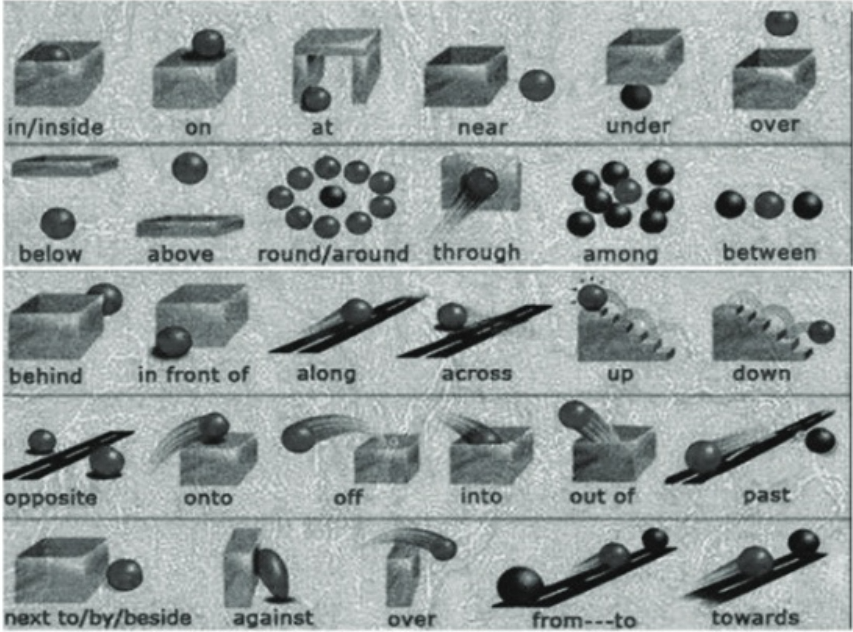
- This lesson is ______ prepositions.
- He goes _____ bed ._____ten o'clock.
- We reached there _____ lunch time.
- She sat _____ me.
- There is no difference _______ them.
- There is a school _______ our house.
- The cat sat _______ the table.
- I went ______ Dhaka ______ my father.
- We cannot live ______ water.
- The dog jumped ____ the wall.
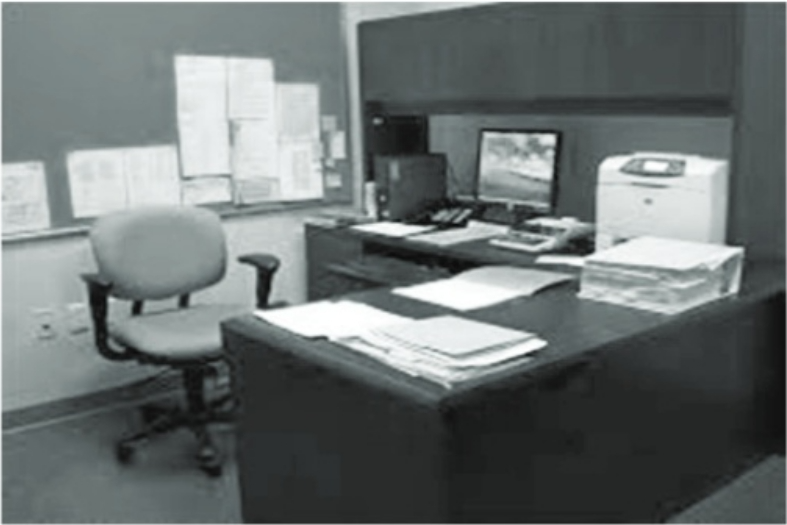
D Look at the picture and describe the positions of things in it using prepositions. One is done for you:
In the picture, the file is on the table.
A Read the following passage and notice the words in bold.
Nazma and Diba are good friends. The former is tall but the latter is short. One day they were walking home from school. They were not in a hurry, yet they were walking very fast. Suddenly, Nazma's knee started hurting so she stopped walking. Diba also stopped and asked her what had happened. Nazma said that she could not walk because her left knee was hurting.
The words in bold in the passage have linked or joined together two or more words or ideas, phrases and clauses in a sentence.
These types of words are called conjunctions. They are often called linking words.
B Write few sentences on 'Your English Teacher' using as many conjunctions as possible.
C Read the following sentences and notice the words in bold letters:
Alas! He died at an early age.
Wow! What a nice gift!
Ugh! My teeth are aching.
Hurrah! We have won the match.
These are interjections. An interjection is a part of speech which expresses a strong feeling of joy, sorrow, surprise or disgust.
D Now use appropriate interjections to complete the following sentences:
- __________ ! What a beautiful garden!
- __________ ! He could not escape the accident.
- __________ ! I have a bad headache.
- _________ ! We have defeated them.
Read more